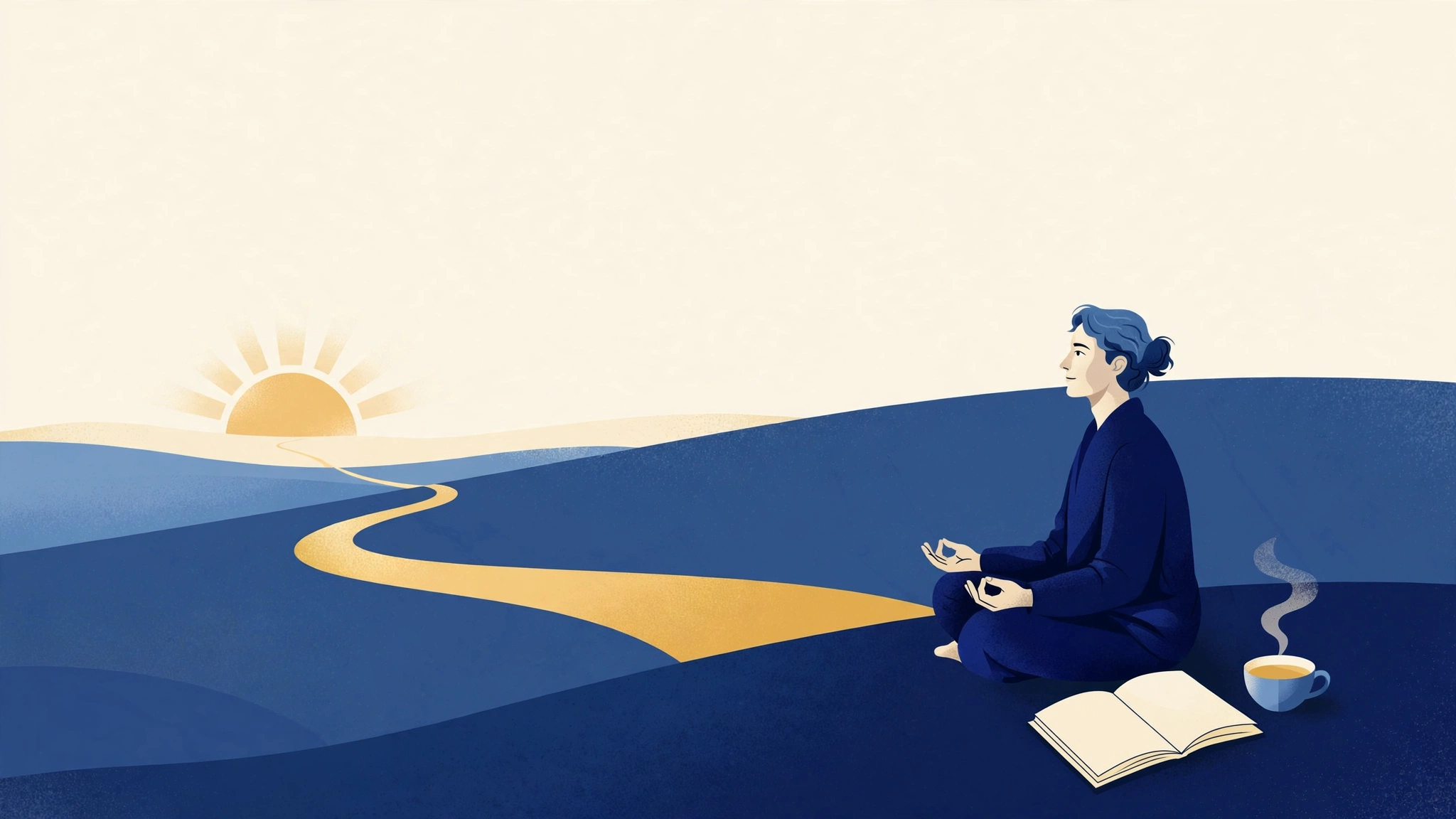
You can achieve more without sacrificing peace of mind by doing what matters with a clear mind, reasonable limits, and sustainable energy. The path is not doing everything. It is choosing a few meaningful aims, protecting your attention, and working in a way you can repeat.
If you want progress yet feel pressure, overwork, worry, distraction, or guilt when you slow down, you are not failing at ambition. You may be using urgency as a substitute for priority. Achievement and peace of mind can support each other when success is defined by values, sustainable effort, and presence rather than constant hurry.
Achievement, Productivity, and Peace of Mind: What They Really Mean
Achievement is progress toward what matters to you. Productivity is output. Peace of mind is a steadier relationship with your thoughts, emotions, responsibilities, and uncertainty. It does not mean zero problems. Bills, deadlines, and difficult conversations can still be present while you meet them with more clarity.
More output does not always mean more progress. Rest and recovery can be part of effective work. A packed day that leaves you depleted is not the same as a focused day that moves the real goal. True personal development balances drive with calm.
Circumstances still count. Poverty, illness, trauma, grief, discrimination, caregiving, and other forces outside your control are not a peace-of-mind failure. Inner practice can support how you meet a hard season. It does not pretend the season is imaginary.
Common Thieves of Peace in the Pursuit of Goals
Certain habits quietly erode your calm as you chase goals. Recognize them to reclaim your peace.
- Unclear priorities and too many goals spread your energy thin.
- Urgency addiction and constant notifications keep you reactive.
- Perfectionism and fear of judgment create endless pressure.
- Comparing your private process to others' public results breeds doubt.
- Weak boundaries and difficulty saying no lead to overload.
- Avoiding rest until exhaustion invites burnout.
- Confusing worry with preparation traps you in mental loops.
- Pursuing inherited definitions of success ignores your own values.
12 Practical Ways to Achieve More Without Stress
Here are direct steps. Each builds sustainable success. Start with one or two.
- Define what “enough” means for this season. Write three signs of sufficient progress. Adjust as life shifts.
- Choose one to three meaningful priorities. List all goals. Pick the top few. Park the rest.
- Plan the day around energy as well as time. Notice your peak hours. Schedule key work there.
- Use single-tasking and focused work blocks. Set a timer for 25 - 50 minutes. One task only.
- Create a start and stop ritual for work. Begin with a deep breath. End by noting tomorrow's first step.
- Schedule recovery before the calendar fills. Block time for walks, reading, or quiet.
- Set communication boundaries. Turn off non-essential alerts. Check email at set times.
- Replace rumination with a written next action. When stuck, ask: What is one small step? Write it down.
- Practice progress reviews instead of self-criticism. Weekly, note wins and lessons. No judgment.
- Ask for help, coaching, or accountability. Share a goal with a trusted person. Check in regularly.
- Align goals with values and relationships. Ask if this goal nourishes what you care about most.
- Protect sleep, movement, nourishment, and restorative connection. Treat these as non-negotiable fuel.
Why Meditation Can Support Peace of Mind
Meditation trains attention. Many people find the benefits of meditation include a calmer response to daily pressure, a little more room before reacting, and a clearer sense of what matters. It can support mindfulness and success by building awareness without forcing a mood.
You learn to return attention to one object, such as the breath, a word, or a simple sensation. Thoughts still arise. You notice them without automatically obeying every one. Over time, a pause can form between stimulus and response. That pause is often where a better choice becomes possible.
Emotions and body signals may appear earlier: a tight jaw, a rushed breath, a sudden urge to prove yourself. You can relax the body while remaining alert. Then you return to your values and choose the next useful action. Consistency comes from repetition, not from chasing a special experience on the cushion.
Meditation is a personal development practice. It is not a replacement for qualified medical or mental-health care, and it does not eliminate stress or guarantee a result. If it brings up distressing memories, panic, or strong symptoms, stop and seek support from a qualified professional.
A Beginner’s Guide: How to Meditate
Start small. Choose five to ten minutes at a consistent time. Sit comfortably with stable posture. Eyes closed or soft gaze.
Notice natural breathing. No forcing. Count a few breaths if helpful. Use breath as anchor.
Attention wanders. Name it gently - “thinking.” Return to breath. Allow thoughts and emotions without solving all at once.
Close by choosing one peaceful, useful action for the day.
Busy day version: Three conscious breaths before a meeting. Walk mindfully for one minute. Pause between tasks for a one-minute breath focus.
Silva-Inspired Practices for Deeper Calm
Silva UltraMind ESP is an educational mental-training program. It teaches guided relaxation, a relaxed alert or Alpha-level focus as a program teaching, self-awareness, constructive visualization, mental rehearsal, and Beneficial Statements, which are constructive statements you can pair with action.
These practices can help a person settle attention, picture a process, and act with more intention. They do not control external events, replace practical work, or promise a particular result.
Explore Silva UltraMind ESP if you want a structured two-day seminar for this kind of mental training. Explore The Master Key System if you want a longer weekly practice for attention, thought, and follow-through. For one-to-one support around priorities and peace, Explore Personal Coaching with Paul. If you are unsure which path fits, book a discovery call with Paul.
The Calm Action Loop: Linking Meditation to Achievement
Use this loop to achieve more without stress: Pause. Observe. Clarify. Choose. Act. Review. Meditation can support the first two steps. Clear priorities and a written next action support the rest.
- Career or business goals: Pause before a decision. Observe tension. Clarify the value. Choose a focused step, like one outreach email. Act. Review what worked.
- Health and habits: Notice urge to skip movement. Clarify energy need. Choose a 10-minute walk. Act. Review how you feel after.
- Relationships and boundaries: Feel resentment building. Observe it. Clarify your need. Choose a clear “no, thank you.” Act kindly. Review the peace gained.
- Creative or spiritual practice: Mind wanders in writing. Pause. Observe distraction. Clarify the spark. Choose five focused minutes. Act. Review the flow.
Your 7-Day Experiment for Peace and Progress
Try this as an experiment, not a guaranteed transformation. Seven days will not rewrite a life. They can show you whether a calmer way of working can survive an ordinary week.
- Day 1: Write what “enough” means for this week. Keep it specific enough to recognize at a glance.
- Day 2: Sit for five minutes of meditation at a consistent time. When the mind wanders, return without scolding yourself.
- Day 3: Choose one to three priorities. Park the rest on a later list.
- Day 4: Complete one focused work block on the most important task, with notifications off.
- Day 5: Set one boundary, such as a time you stop checking messages or a request you decline.
- Day 6: Do one recovery activity on purpose: a walk, a meal without a screen, or time with someone who restores you.
- Day 7: Review the week. Keep what supported both progress and peace. Shrink or change what did not.
Journaling Prompts for Clarity and Peace
- What matters most in this season?
- What am I treating as urgent that is not truly important?
- What would enough look like today?
- What thought keeps pulling me away from peace?
- What can I control, influence, or release?
- What action would honor both my ambition and my wellbeing?
- What support would make this path more sustainable?
When to Seek Additional Support
Meditation, coaching, and mental training are not the right first tools for every struggle. If you face persistent anxiety, depression, panic, trauma-related distress, severe sleep disruption, an inability to function, or thoughts of self-harm, seek qualified local professional help. Use urgent support where appropriate. If you are in immediate danger, contact local emergency services or a crisis line in your area.
This article cannot diagnose you. Inner practice does not replace medical or mental-health care.
You can make meaningful progress without treating peace of mind as a luxury you earn later. Start with one priority, one sitting, and one honest review. Build from there.
If you want structure, Explore Silva UltraMind ESP, Explore Personal Coaching with Paul, or Explore The Master Key System. When you want help choosing the next step, book a discovery call with Paul.
To Your Success,
Coach Paul